Tor Ilek Expedition
Chasing SunlightThe Tor Ilek Expedition is Jonathan Heights’s deliberate return to the ruined city of Tor Ilek, an undertaking that converts archaeological knowledge into immediate danger and material profit. After a week of following the Khorus River, the Endeavor reaches the ancient city, whose crumbling domes and arches leech color from the river until its water emerges pale and ghostly. Jonathan does not approach Tor Ilek as an unknown ruin: he has visited it before, knows that ordinary explorers have stripped its easily accessible treasures, and has come for a particular chamber and the device hidden within it. The expedition therefore begins as a calculated recovery mission, but its logic of control steadily gives way to the city’s alien mechanisms and hostile life.
Arrival at the Ruined City
The Endeavor approaches Tor Ilek under zint lights, with the river passing beneath rotted bridges and around tumbled arches. Rust marks the dark stone where the metal skeletons of demolished towers and spires curl upward from the ruins. Jonathan recognizes a knurled dome whose broken iron buttresses resemble twisted teeth and directs Captain Montgomery to tether the airship to southern spikes, identifying a route into the structure. Montgomery brings the ship around against wind and inertia while the envelope compresses and the vessel descends toward a hook-like remnant protruding from the dome.
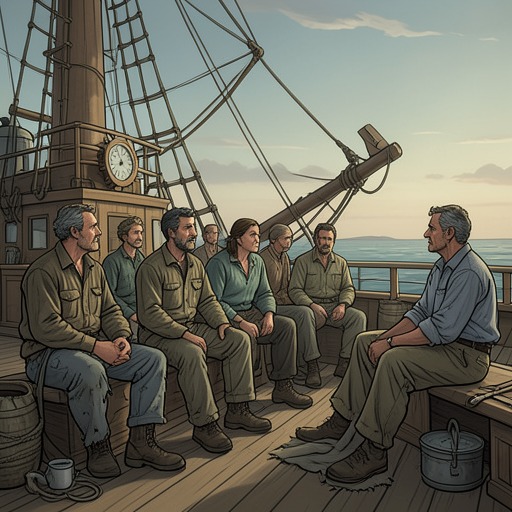
The landing is treated as a military operation rather than a sightseeing stop. Airmen first secure the ship with chains and then install descent lines, while Jonathan notices movement at the edge of the spotlights and orders the forward zint-cannons to fire. The artillery scatters the uncertain forms lurking near the metal spine without damaging the ancient stone, which appears capable of outlasting even Beacon’s civilization. Jonathan estimates that seven or eight men armed with swords and guns will be needed for the excursion and insists that someone remain at the cannon so that nothing can sever the six-inch steel chains. His stated timetable is several hours, and his objective is narrowly defined: there are no people to negotiate with, only things, and the party must reach one particular chamber before returning to the Endeavor.
Passage Through Tor Ilek
The expedition descends by stairs built for bodies unlike human ones. The steps are unusually long and slanted, worn by parallel grooves that suggest ages of strange traffic. A concealed door opens through a weathered section of stone that slides outward and sideways on hidden mechanisms. Jonathan had left the door open during his previous visit, so its closure becomes an immediate uncertainty: either another mechanism has acted, or someone has closed it. The party proceeds downward through a stairwell where apertures briefly reveal deserted halls and rooms, finding no easily recoverable treasure because earlier explorers have already searched the accessible areas.
The ruins nevertheless remain inhabited. A zint rifle kills a long-limbed, long-jawed creature half the size of a man, whose scream sounds disturbingly human and whose corpse leaves a metallic smell of rust in the stairwell. Antomine explains that innumerable creatures dwell in the dark, particularly in places like Tor Ilek, and connects their presence to the walls surrounding human cities. Beneath the ancient stone and metal, the Khorus River gathers in vast caverns that generate hostile forms of life, turning the ruined city into both an archaeological site and an ecological hazard.
At the base of the stairs, Jonathan’s lantern reveals a section of floor that is somehow extra. The party can trace a perfect circle within the area illuminated by their ordinary lights, yet something more has been compressed inside that apparently complete boundary. The phenomenon exemplifies Tor Ilek’s impossible geometry: the city does not merely contain unusual spaces but makes ordinary measurements unreliable. Jonathan identifies it as one of the mechanisms that still works and warns the party not to touch anything moving, comparing the machinery to ordinary industrial equipment only to emphasize that even familiar kinds of danger are sufficient here.
The route ends at a large door covered with metal circles and symbolic inscriptions. The circles move according to an arcane calculus, and several symbols are hidden within the extra degrees used by the builders. Normally, opening the lock would require days or weeks of guesswork and the interpretation of partially translated symbols. Jonathan instead calls on Eleanor McAvey. She walks toward the door and fades from sight, then opens it from the far side, revealing that her knowledge includes a way through defenses that are inaccessible to the rest of the party. Jonathan does not ask her to explain the method; the expedition advances because her unexplained ability supplies the key his archaeological expertise cannot provide.
The Hidden Chamber and the Navigator
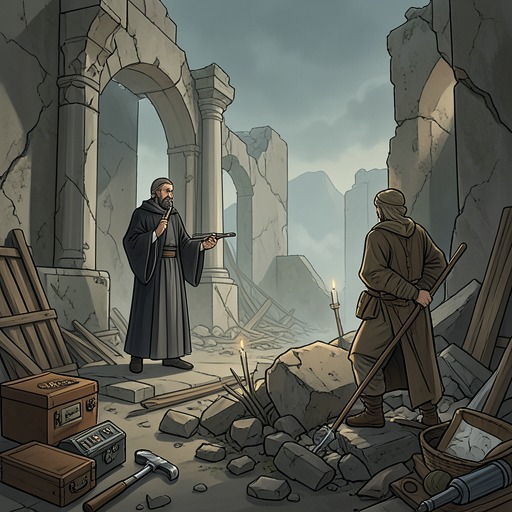
Beyond the door, the party crosses a defile and reaches an intact monolith amid collapsed stone. Jonathan identifies it as a defensible position and activates its extra degrees, causing a passage to unfold in a direction that no ordinary architecture could contain. Antomine’s guards take station at the entrance while the rest of the party searches the adjoining rooms. Jonathan warns that creatures may be nesting there, although the area was empty on his previous visit, and permits the airmen to take portable fragments of the past. The expedition thus combines a specific technological objective with opportunistic looting, as the crew gathers statues of grotesque nonhuman figures, rings, spirals, dark gems, and tarnished gold.
At the far end of the hall, Jonathan finds a pedestal bearing a mechanism of interlocking rings. Some of its symbols correspond to those on Jonathan’s maps. He places his lantern beside it and uses lengths of wire to copy the arrangement, wrapping the wire around the mechanism and fitting each completed circle into a sliding armature. The resulting device resembles a compass, but its function depends on geometries that defy human comprehension. Jonathan does not claim to understand the original builders’ secrets, or even to know whether the method came from his father, Reginald Heights, or from older explorers whose work his father merely transmitted. His achievement is therefore an act of reconstruction rather than invention: he reproduces a lost instrument from fragments of inherited knowledge.
The work is physically demanding. The required angles and distances resist his hands, and on his previous visit he could complete the construction only through prolonged rests and brute effort. This time, the sunlight within him drives both his fingers and his mind, giving the recovery mission a supernatural resource that changes Jonathan’s relation to the past. Around him, the crew searches rooms, and Eleanor is summoned to breach doors that refuse to open. Antomine watches Jonathan rather than taking interest in the recovered trinkets, while every potentially dangerous object is brought before him for inspection.
The relics form a small fortune on the right market, and the loot is packed into cloth sacks until a sizeable pile accumulates. Jonathan suspects that most of it is not truly dangerous, but respects the possibility that a malevolent artifact could disable or destroy the Endeavor before it reaches its destination. The expedition’s value is therefore double-edged: the ruins offer wealth, yet every object removed from them may carry a threat. When Jonathan completes the ring-and-armature device, the surrounding architecture seems to stretch and relax simultaneously. New doorways appear in corners that previously contained none, prompting the airmen to return for still more objects and deepening the crew’s cupidity at precisely the moment the ruin begins to reveal that its mechanisms are active.
The altered space is followed by a warning from the environment itself. A long, low sound vibrates through the decrepit stone, making the metal treasure clink, while a hot breeze overwhelms the constant sigh of the river. An airman returns at speed, dragging a companion who babbles incoherently. The party looks to Jonathan for guidance, and his response is a single imperative: flee. The expedition’s central reversal occurs here. The party enters Tor Ilek believing that careful preparation, armed guards, zint illumination, and Jonathan’s prior experience can contain the risk; it leaves when the city’s deeper machinery and whatever it has awakened make further exploration impossible.
Wider Expeditionary Context
The Tor Ilek Expedition belongs to a larger eastward venture whose success depends on Jonathan Heights’s accumulated knowledge of hostile geography, forgotten infrastructure, and nonhuman environments. Before reaching the ruins, the Endeavor follows the Khorus River south and east, while Jonathan relies on charts made during earlier expeditions, including the disastrous voyage of the Discovery. The route is not a simple progression into empty wilderness: the expedition must pass through regions where raw luminiferous terrestrite may be needed for zint fuel, where settlements and supply points are uncertain, and where the boundaries of human civilization are enforced by technology and violence. At Autochthon Reach, Jonathan has already seen how human districts are separated from darker forces by a great zint-lit gate, while the surrounding buildings and their inhabitants reveal that influence runs in both directions. These experiences make Tor Ilek part of a continuous frontier system rather than an isolated ruin: every advance eastward requires navigation through material, biological, and ontological hazards that Beacon’s infrastructure can only partially restrain.
The journey also establishes the expedition’s dependence on waterways as both routes and threats. Jonathan directs Captain Montgomery to follow the Khorus River, and later the river becomes the defining presence beneath Tor Ilek, losing its color as the city draws something vital from it. Elsewhere, the Autochthon Sea carries tales of phosphorescent forms stretching across the horizon, while the route toward Angkor Leng requires the Endeavor to follow a strange compass through landscapes whose roads and ruins only resolve into a city when the ship reaches the correct angles. The expedition therefore treats water and geography as active forces that shape movement, conceal destinations, and expose the limits of ordinary maps. Tor Ilek’s river, drained to a ghostly pallor beneath the city, is the most concentrated expression of that pattern: the ruin does not merely stand beside a route of travel but alters the route’s substance.
The expedition’s encounters beyond Tor Ilek reinforce the unstable relationship between human exploration and nonhuman life. Above Beacon, migrating Glacilium bring snow and Glaciwing attacks, prompting soldiers to mount unfamiliar zint weapons on the city’s towers. In the Verdant Expanse, a caravaneer approaches the Endeavor as an intelligent traveler rather than a monster, speaking with Jonathan in whistles and clicks; moments later, the human party witnesses the caravaneers tear into the carcass of a hunted beast in a violent feeding frenzy. These scenes complicate the expedition’s claim to mastery. Jonathan can speak across species, recognize useful weapons, and plan hunting or salvage operations, but the living world repeatedly exceeds the categories through which his party tries to organize it. Tor Ilek’s creatures belong to the same continuum: they are not supernatural decorations around an archaeological puzzle, but inhabitants of an environment whose history and mechanisms remain inseparable from its ecology.
The ruins’ recovered wealth also binds the expedition to the economic life of Beacon. The Tor Ilek relics become valuable because the city is known to the Exploration Society and its architecture has long fascinated collectors of forbidden knowledge. After the Endeavor returns, the destruction of Tor Ilek makes even minor objects from the city sought-after commodities, and nearly every airman becomes wealthy enough to consider leaving the profession. Their fortunes attract thieves and opportunists, but the veteran airmen prove difficult targets, and some would-be attackers disappear, leaving only scorched shadows. The expedition thus produces consequences far beyond Jonathan’s private recovery of the navigator: it redistributes wealth, changes the crew’s future, and turns the ruins into a cultural and commercial absence whose fragments grow more valuable after the city itself is gone.
Those consequences contribute to Beacon’s unsettled period after the Endeavor’s return. Observers give the season competing names, including the Winter of Blood and the mocking Winter of the Shadow, because the expedition’s aftermath coincides with an unusual concentration of violence and strange incidents. Yet the city does not treat the next fitting-out of the Endeavor as an extraordinary undertaking. When Captain Montgomery prepares the airship for another voyage, the departure is regarded as little more than a minor expedition, despite the wealth, danger, and destruction associated with the previous one. This contrast gives the Tor Ilek Expedition a larger historical irony: an event that permanently alters a ruin, enriches its survivors, and feeds public rumors is absorbed by Beacon’s culture of recurring exploration almost as soon as it ends.